Agentic AI is transforming artificial intelligence by enabling systems to plan tasks, make decisions, and take actions toward specific goals. To achieve these goals, AI agents often need to interact with external tools, databases, and applications.
This is where Model Context Protocol (MCP) becomes useful. It provides a standardised way for compatible AI applications to access external tools and information.
As a result, understanding how Agentic AI and MCP work together can help developers build more capable and connected AI systems.
What Is Agentic AI?
Agentic AI refers to AI systems that can work toward specific goals by planning steps, selecting actions, using tools, and evaluating results.
Unlike systems that only generate responses, AI agents can perform multi-step workflows with varying levels of autonomy. For example, they may gather information, interact with software, and adjust their approach based on the results.
However, the capabilities of an AI agent depend on its underlying model, available tools, workflow design, and permissions.
Why Do AI Agents Need External Tools?
Large Language Models (LLMs) can understand instructions and generate responses. However, they do not automatically have access to every database, application, or real-time information source.
To overcome this limitation, external tools allow AI agents to extend their capabilities. For example, an agent may retrieve information from a database, access a document, or interact with an approved API.
Therefore, connecting these tools effectively is an important part of building practical Agentic AI systems.
What Is Model Context Protocol (MCP)?
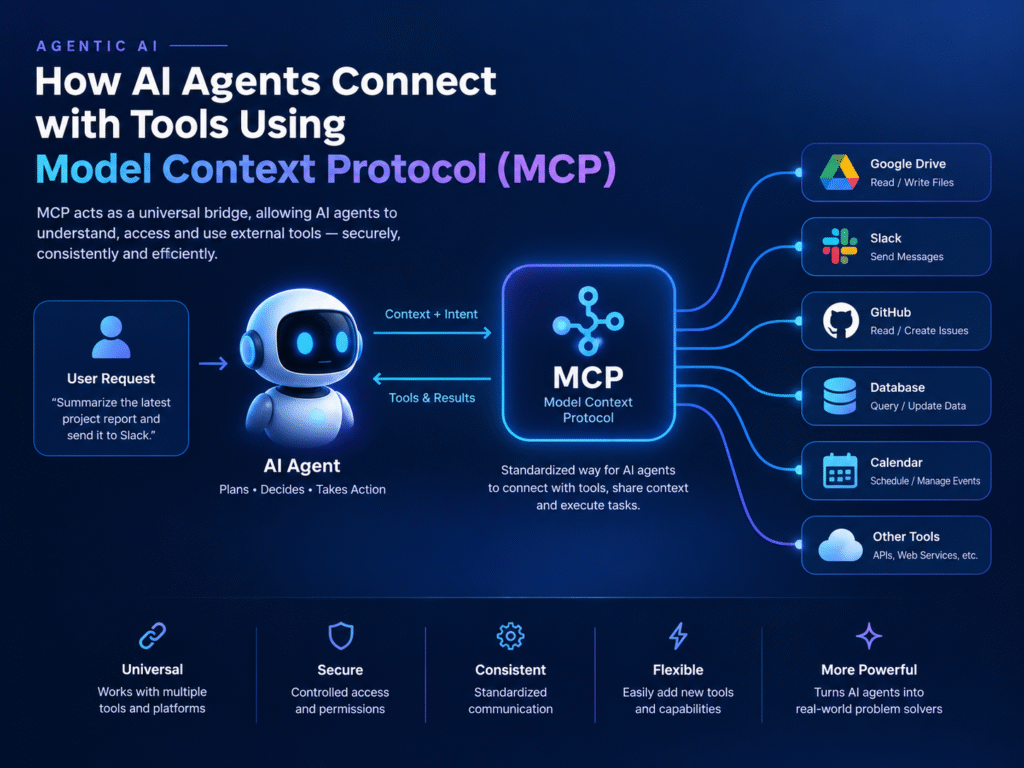
Model Context Protocol is an open protocol that standardises how compatible AI applications connect with external tools and data sources.
Traditionally, developers might need to build different integrations for different applications. With MCP, compatible AI applications can use a common protocol to connect with MCP servers that expose specific capabilities.
Additionally, MCP can provide access to tools, resources, and prompt templates, depending on the server implementation.
It is important to understand that MCP does not create intelligence or autonomy by itself. Instead, it provides a communication layer that can help AI agents access external capabilities.
How Do Agentic AI and MCP Work Together?
Agentic AI provides the goal-oriented behaviour, while MCP can provide a standardised connection to external capabilities. Together, they can support workflows that involve multiple steps and external tools.
A typical workflow may look like this:
- Goal identification: First, the AI agent understands the user’s request.
- Task planning: Next, the agent determines which information or actions are required.
- Tool discovery: Then, the AI application identifies available tools through an MCP connection.
- Tool execution: After selecting a suitable tool, the application calls it through the MCP client-server interaction.
- Result evaluation: The agent then processes the returned information and determines the next step.
- Task completion: Finally, the agent provides a result or continues the workflow.
Of course, the exact process depends on the agent’s architecture and the permissions granted to it.
Real-World Example of an MCP-Connected AI Agent
Imagine an AI assistant designed to help a software development team manage project tasks.
For example, a developer might ask the assistant to find an open task. The agent could interpret the request, retrieve relevant project information through an approved tool, and prepare a summary.
Furthermore, if authorised, it could create or update a task using another available tool. MCP can provide a standardised connection to these capabilities, while the surrounding AI system manages the reasoning and workflow.
In this way, Agentic AI can interact with existing software rather than simply generating text.
Benefits of Using MCP in Agentic AI Development
Simplified Integration
MCP provides a common protocol for connecting compatible AI applications with external capabilities. Consequently, developers can use a more consistent approach when integrating supported tools.
Reusable Connections
An MCP server can expose capabilities to multiple compatible clients. As a result, developers may reduce the need to build separate integrations for every application.
Extended Capabilities
AI agents can access supported information sources and tools beyond the model’s built-in knowledge. For instance, an agent may retrieve project data or interact with an approved external service.
Flexible Development
Developers can combine language models, external services, and custom tools to build AI workflows. Additionally, they can expand these workflows as new requirements emerge.
Security Considerations
Giving AI agents access to external tools requires careful security planning. Although these integrations can make AI systems more useful, they also introduce risks that must be managed.
Developers should use appropriate permissions, validate inputs, protect sensitive data, and monitor tool execution. For example, actions that modify important records or create irreversible changes may require explicit human approval.
Most importantly, MCP does not automatically make an AI system secure. Safe implementation depends on trusted integrations, access controls, and effective monitoring.
How to Start Learning Agentic AI
Aspiring developers can begin by learning Python programming, Generative AI fundamentals, and Large Language Models.
Once they understand these fundamentals, they can move on to API integration, tool calling, AI agent workflows, and MCP architecture. As a practical starting point, building a simple AI assistant connected to a read-only data source can help them understand how these components work together.
Later, developers can explore multi-step workflows, validation, error handling, and secure tool execution.
Conclusion
Agentic AI is enabling systems to move beyond generating responses and perform goal-oriented tasks. To support these tasks, connecting AI agents to external tools is essential for many practical applications.
Model Context Protocol provides a standardised way for compatible AI applications to access tools and information. Consequently, developers can use it to build more connected AI workflows.
Ultimately, learning Agentic AI, Python, LLM integration, and MCP can help aspiring developers strengthen their understanding of modern AI engineering.
Explore emerging AI technologies and software development skills with Aitrich Academy.
Frequently Asked Questions
What is Agentic AI?
Agentic AI refers to AI systems that can plan and perform actions toward defined goals, often using tools and evaluating results.
What is MCP in Agentic AI?
MCP is an open protocol that helps compatible AI applications connect with external tools and information sources.
Is MCP necessary for Agentic AI?
No. AI agents can connect to tools through other methods. However, MCP offers a standardised approach when compatible integrations are available.
What skills are useful for Agentic AI development?
Python, Generative AI, LLMs, API integration, tool calling, workflow design, and security fundamentals are useful skills to develop. Together, these skills provide a foundation for building and maintaining AI-powered applications. tool calling, workflow design, and security fundamentals are useful skills to develop.