Digital marketing is changing quickly. Businesses are no longer using AI only to generate content, write captions, or create images. A new generation of AI called Agentic AI is taking marketing automation to the next level.
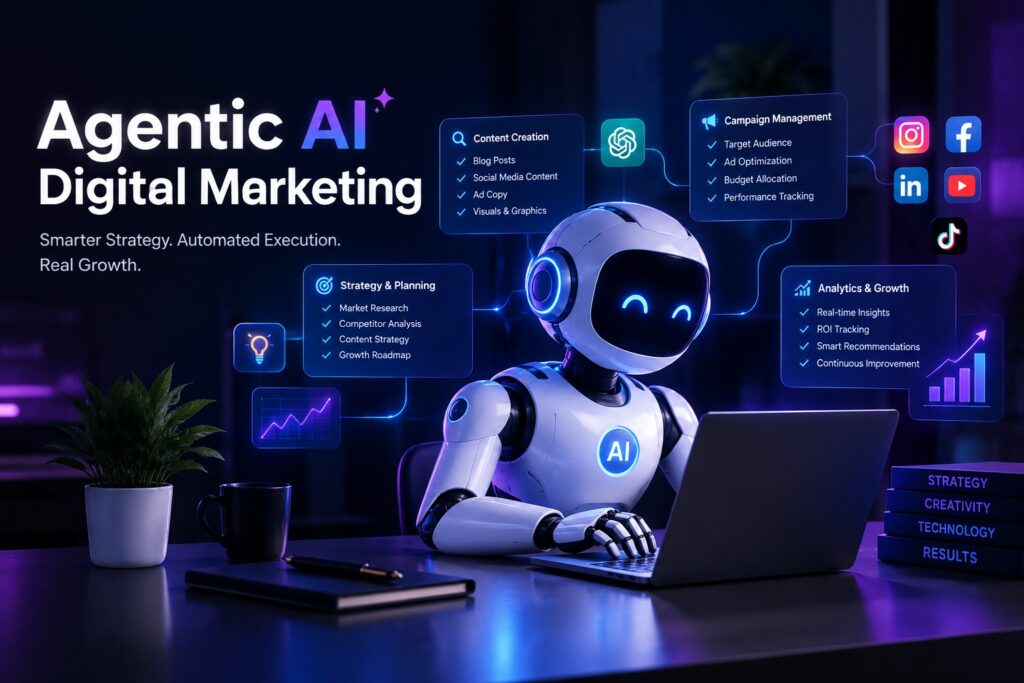
Agentic AI in digital marketing allows AI systems to understand goals, make decisions, perform tasks, analyze results, and adjust strategies with less human intervention.
Instead of simply asking an AI tool to write a blog or create an ad copy, marketers can use AI agents to handle a complete workflow.
For example, an AI agent could research a topic, identify keywords, create content, optimize it for SEO, monitor performance, and suggest improvements.
What Is Agentic AI?
Agentic AI refers to AI systems that can work toward a specific goal by planning actions, using tools, making decisions, and adapting based on results.
Traditional AI generally responds to a specific instruction.
For example:
“Write a Facebook ad for a digital marketing course.”
Agentic AI can work on a broader objective:
“Generate qualified leads for a digital marketing course.”
The AI agent could research the audience, create campaign ideas, prepare ad variations, analyze campaign data, identify poor-performing ads, and recommend changes.
This makes Agentic AI particularly useful for digital marketing.
How Is Agentic AI Different From Traditional AI?
Traditional AI usually works based on individual prompts.
Agentic AI focuses more on completing a goal.
The difference can be understood simply:
Traditional AI:
You give a task → AI gives an output.
Agentic AI:
You give a goal → AI plans → AI performs tasks → AI analyzes results → AI takes the next action.
This does not mean marketers will completely disappear. Human supervision is still important, especially for strategy, brand communication, budgets, privacy, and decision making.
How Agentic AI Can Be Used in Digital Marketing
Agentic AI can support almost every major area of digital marketing.
1. SEO
SEO requires continuous research, content creation, technical optimization, competitor analysis, and performance monitoring.
AI agents can assist marketers by:
- Finding keyword opportunities
- Analyzing competitors
- Identifying content gaps
- Creating content briefs
- Suggesting internal links
- Monitoring rankings
- Analyzing Google Search Console data
- Finding technical SEO issues
- Suggesting content updates
For example, instead of manually checking which blog posts have lost traffic, an AI agent could monitor performance and identify pages that may need updating.
The marketer can then review the recommendations and make the final decisions.
2. Content Marketing
Content marketing involves much more than writing blog posts.
A complete content workflow includes:
- Topic research
- Keyword research
- Content planning
- Writing
- SEO optimization
- Publishing
- Promotion
- Performance analysis
Agentic AI can connect these steps into a single workflow.
This can help marketers reduce repetitive work and spend more time on strategy and creative thinking.
3. Social Media Marketing
Social media requires regular content and continuous monitoring.
AI agents can help with:
- Content ideas
- Caption generation
- Content calendars
- Hashtag research
- Comment monitoring
- Audience analysis
- Performance reports
- Content repurposing
For example, one long-form blog could be converted into Instagram content, LinkedIn posts, short video ideas, and email content.
The marketer can then review and publish the content according to the brand’s style.
4. Paid Advertising
Digital advertising requires constant monitoring.
Agentic AI can analyze:
- Click-through rate
- Cost per click
- Conversion rate
- Cost per lead
- Audience performance
- Ad creative performance
An AI agent could identify an underperforming campaign and recommend changes to targeting, creative, budget allocation, or messaging.
However, automated changes to advertising accounts should always have appropriate controls and human oversight.
5. Email Marketing
Email marketing can also benefit from Agentic AI.
AI agents can help marketers segment audiences, personalize messages, analyze campaign performance, and identify opportunities for follow-up.
For example, an agent could identify users who opened an email but did not complete an enquiry and recommend a follow-up campaign.
Agentic AI and Personalization
One of the biggest advantages of AI agents is the ability to work with large amounts of customer and campaign data.
This can help businesses create more personalized experiences.
Instead of sending the same message to everyone, businesses can potentially use AI to identify:
- Customer interests
- Previous interactions
- Purchase behavior
- Content preferences
- Engagement patterns
This allows marketing teams to create more relevant campaigns.
Benefits of Agentic AI in Digital Marketing
Saves Time
Repetitive marketing tasks can consume hours every week. AI agents can automate many of these processes.
Faster Decision Making
AI can process large amounts of information much faster than manual analysis.
Better Workflow Automation
Different marketing activities can be connected into a single workflow.
Continuous Monitoring
AI agents can monitor campaign performance and identify changes that require attention.
Improved Productivity
Marketers can spend less time on repetitive tasks and more time on strategy, creativity, and customer relationships.
Challenges of Agentic AI
Agentic AI is powerful, but it is not a replacement for human expertise.
There are several challenges marketers need to consider.
Accuracy
AI can still make incorrect assumptions or generate inaccurate information.
Brand Consistency
Automatically generated content may not always match the brand’s tone and values.
Privacy
Marketing systems often work with customer data. Businesses must handle this information responsibly.
Human Oversight
Important decisions involving advertising budgets, customer communication, and business strategy should not be blindly delegated to AI.
Over-Automation
Automating everything can create poor-quality content and repetitive customer experiences.
The goal should be smart automation, not complete automation.
Agentic AI vs AI Automation
AI automation usually follows predefined workflows.
For example:
If a customer submits a form, send an email.
Agentic AI can operate with a broader objective and determine which actions may be necessary to achieve it.
For example:
Increase qualified leads from the website.
The AI agent may analyze website data, identify conversion problems, suggest content changes, monitor results, and recommend the next steps.
This makes Agentic AI more flexible than traditional rule-based automation.
The Future of Agentic AI in Digital Marketing
The future of digital marketing is likely to involve a combination of human marketers and AI agents.
Marketers will continue to provide:
- Strategy
- Creativity
- Brand direction
- Business knowledge
- Ethical judgment
- Final approval
AI agents can handle more of the repetitive operational work.
This could change the role of digital marketers from simply executing tasks to managing intelligent marketing systems.
A marketer may eventually manage several AI agents responsible for SEO, content, advertising, analytics, social media, and customer engagement.
How Digital Marketers Can Prepare for Agentic AI
Digital marketers do not need to become AI engineers.
But they should understand how AI can be integrated into their existing workflow.
Start by learning:
- AI prompting and context management
- Marketing automation
- SEO and content strategy
- Analytics and data interpretation
- AI tools and agents
- Workflow design
- Human review and quality control
The most valuable skill will not simply be knowing how to use AI.
It will be knowing where AI should be used, where it should not be used, and how to verify its output.
Conclusion
Agentic AI in digital marketing is moving AI from simple content generation toward goal-based marketing automation.
It can help marketers research, plan, create, analyze, optimize, and automate different marketing activities.
But businesses should not automate marketing blindly. AI should support human expertise rather than replace strategic thinking.
The marketers who learn how to combine AI agents, marketing knowledge, data, creativity, and human judgment will be better prepared for the next stage of digital marketing.
Frequently Asked Questions
What is Agentic AI in digital marketing?
Agentic AI in digital marketing refers to AI systems that can work toward marketing goals by planning tasks, using tools, analyzing information, making decisions, and adapting based on results.
How can Agentic AI help with SEO?
Agentic AI can assist with keyword research, competitor analysis, content planning, internal linking, performance monitoring, content updates, and technical SEO analysis.
Is Agentic AI going to replace digital marketers?
Not completely. Human marketers are still needed for strategy, creativity, brand decisions, ethical considerations, and reviewing AI-generated recommendations.
What is the difference between AI and Agentic AI?
Traditional AI generally responds to specific instructions. Agentic AI can work toward a broader goal by planning and executing multiple actions.
Is Agentic AI useful for small businesses?
Yes. Small businesses can use AI agents to automate repetitive marketing tasks such as content planning, reporting, lead follow-up, and campaign monitoring. However, the level of automation should match the business’s resources and needs.
What skills should digital marketers learn for Agentic AI?
Digital marketers should learn AI tools, automation, SEO, analytics, prompt design, workflow creation, and how to evaluate AI-generated results.