Artificial Intelligence (AI) is transforming industries across the world. From healthcare and finance to education and e-commerce, organizations are using AI to improve efficiency, automate tasks, and make smarter decisions. As AI adoption continues to grow, the demand for skilled professionals is increasing rapidly.
If you’re planning to learn AI, you may be wondering what career opportunities are available after completing your training. The good news is that AI skills can open doors to a wide range of high-paying and future-ready jobs.
In this blog, we’ll explore the top career opportunities after learning Artificial Intelligence and the skills required for each role.
Why is AI a Promising Career?
Artificial Intelligence is one of the fastest-growing fields in technology. Businesses are investing heavily in AI-powered solutions, creating a strong demand for professionals who can design, develop, and manage intelligent systems.
Whether you’re a student, graduate, software developer, or working professional, learning AI can significantly improve your career prospects.
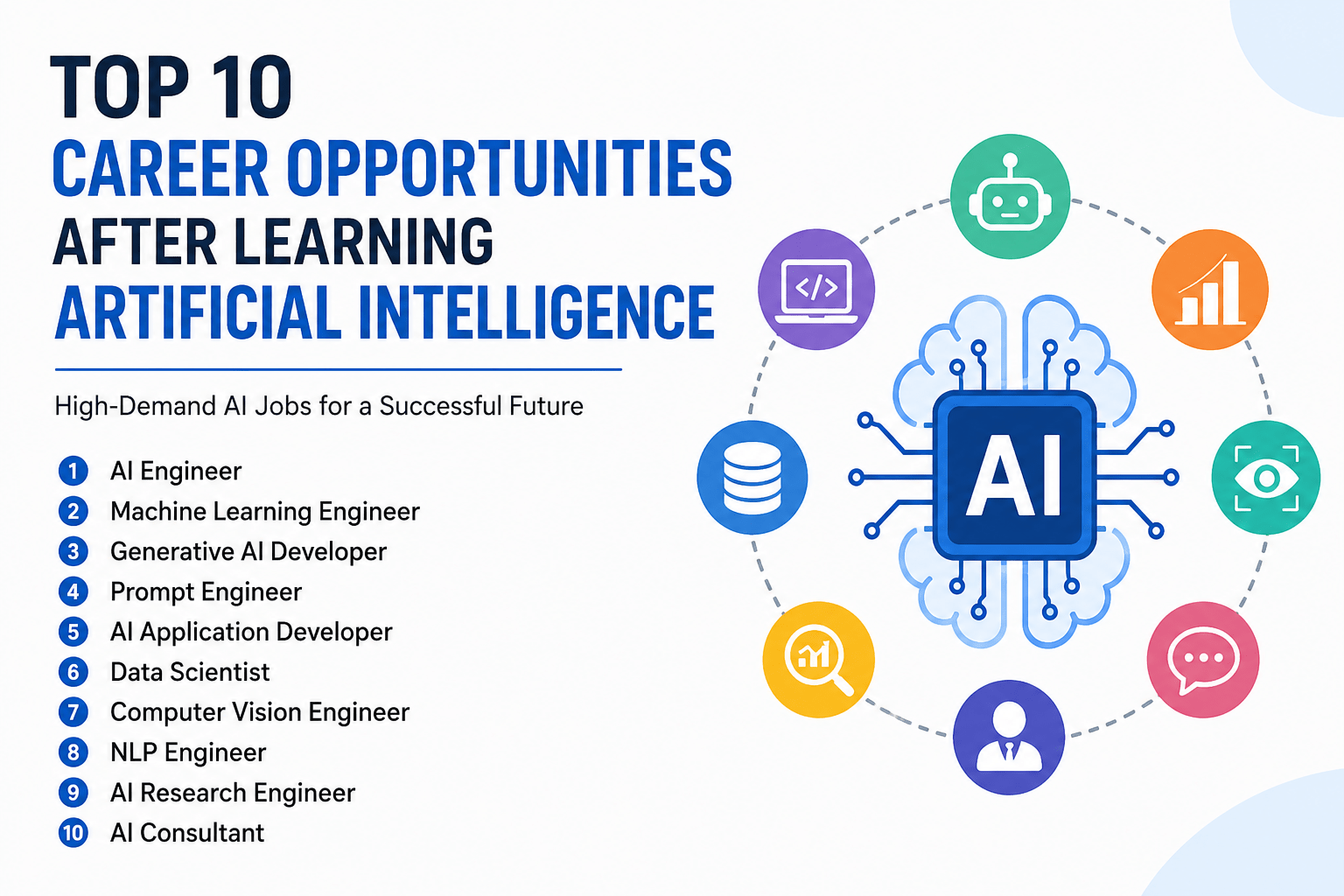
1. AI Engineer
AI Engineers develop intelligent applications that can analyze data, make predictions, and automate business processes. They work with machine learning models, deep learning algorithms, and AI frameworks to solve real-world problems.
Skills Required
- Python Programming
- Machine Learning
- Deep Learning
- APIs
- Cloud Platforms
- Problem Solving
2. Machine Learning Engineer
Machine Learning Engineers create systems that learn from data without being explicitly programmed. They build predictive models used in recommendation systems, fraud detection, image recognition, and more.
Skills Required
- Python
- Machine Learning Algorithms
- Data Processing
- Model Training
- Statistics
3. Generative AI Developer
Generative AI Developers build applications using Large Language Models (LLMs) to generate text, images, code, and other types of content. This role has become one of the most in-demand careers in recent years.
Skills Required
- Python
- Prompt Engineering
- LLMs
- LangChain
- API Integration
- AI Application Development
4. Prompt Engineer
Prompt Engineers design effective prompts that help AI models generate accurate and useful responses. They optimize prompts for chatbots, content generation, automation, and enterprise AI solutions.
Skills Required
- Prompt Engineering
- AI Tools
- Logical Thinking
- Communication Skills
- AI Testing
5. Artificial Intelligence Application Developer
AI Application Developers integrate Artificial Intelligence into web, mobile, and enterprise applications. They create intelligent software that improves user experiences and automates business operations.
Skills Required
- Python
- APIs
- AI Frameworks
- Web Development
- Database Management
6. Data Scientist
Data Scientists analyze large datasets to discover trends and support business decision-making. They often use AI and machine learning techniques to predict outcomes and optimize processes.
Skills Required
- Python
- SQL
- Data Visualization
- Statistics
- Machine Learning
7. Computer Vision Engineer
Computer Vision Engineers develop systems that can understand and interpret images and videos. Their work is widely used in facial recognition, medical imaging, autonomous vehicles, and quality inspection.
Skills Required
- OpenCV
- Deep Learning
- Python
- Image Processing
- Neural Networks
8. Natural Language Processing (NLP) Engineer
NLP Engineers develop applications that allow computers to understand, process, and generate human language. Examples include chatbots, virtual assistants, language translators, and sentiment analysis tools.
Skills Required
- Python
- NLP Libraries
- Transformers
- LLMs
- Deep Learning
9. Artificial Intelligence Research Engineer
AI Research Engineers focus on developing new AI algorithms and improving existing technologies. They work in research labs, technology companies, and innovation teams to solve complex challenges.
Skills Required
- Advanced Mathematics
- Machine Learning
- Research Skills
- Python
- Scientific Thinking
10. Artificial Intelligence Consultant
AI Consultants help organizations identify opportunities to implement Artificial Intelligence in their business operations. They recommend AI solutions, guide implementation, and help companies achieve better productivity.
Skills Required
- AI Knowledge
- Business Analysis
- Communication Skills
- Project Management
- Problem Solving
Skills You Should Learn for a Successful AI Career
Regardless of the career path you choose, developing a strong foundation in the following skills will improve your job opportunities:
- Python Programming
- Artificial Intelligence Fundamentals
- Machine Learning
- Generative AI
- Prompt Engineering
- LangChain
- Retrieval-Augmented Generation (RAG)
- AI APIs
- Git and Version Control
- Real-World Project Development
Practical experience is just as important as theoretical knowledge. Building AI applications and maintaining a portfolio can help you stand out during job interviews.
How to Start Your AI Career
If you’re new to Artificial Intelligence, start by learning Python and the basics of AI and machine learning. As you progress, work on hands-on projects such as AI chatbots, document assistants, recommendation systems, or automation tools. These projects help you apply your knowledge and demonstrate your skills to employers.
Choosing a training program that emphasizes practical learning, mentorship, and career support can also accelerate your growth and prepare you for industry requirements.
Conclusion
Artificial Intelligence is creating exciting career opportunities for professionals across industries. Whether your goal is to become an AI Engineer, Generative AI Developer, Data Scientist, or AI Consultant, learning the right skills can help you build a rewarding and future-ready career.
If you’re looking to gain practical AI skills through industry-oriented training, Aitrich Academy offers comprehensive AI programs that combine expert guidance, hands-on projects, and placement assistance. Start your AI learning journey today and take the first step toward a successful career in one of the world’s fastest-growing technologies.