Modern enterprise applications require more than simple CRUD operations. As business requirements grow, developers need architectures that support scalability, maintainability, and clean business logic. This is where Domain-Driven Design (DDD) with Entity Framework Core becomes highly valuable.
When combined with EF Core, DDD helps developers build clean, scalable, and business-focused applications in the .NET ecosystem.
What is Domain-Driven Design (DDD)?
Domain-Driven Design (DDD) is a software development approach focused on designing applications around business domains rather than databases or frameworks.
The primary goal of Domain-Driven Design is to ensure software accurately reflects real-world business processes.
Key Principles of Domain-Driven Design
- Business-centric architecture
- Rich domain models
- Separation of concerns
- Clean and maintainable code
- Collaboration between developers and business experts
DDD helps teams create applications that are easier to scale, maintain, and evolve over time.
Why Domain-Driven Design Matters in Enterprise Applications
In traditional applications, business logic often becomes scattered across controllers, services, and database layers. This creates tightly coupled systems that become difficult to maintain as the project grows.
Using Domain-Driven Design with Entity Framework Core solves this problem by organizing applications around business rules and domain concepts.
Benefits of Domain-Driven Design with Entity Framework Core
- Better alignment with business requirements
- Improved maintainability
- Scalable enterprise architecture
- Reduced technical debt
- Cleaner testing and code structure
- Easier long-term project maintenance
For large ASP.NET Core applications, DDD creates a more structured and predictable architecture.
Core Concepts of Domain-Driven Design with Entity Framework Core
Understanding the core building blocks of DDD is essential for implementing clean architecture in ASP.NET Core applications.
Domain
The domain represents the business area the application solves, such as banking, healthcare, e-commerce, or logistics.
Entities
Entities are objects with unique identities. Examples include:
- Customer
- Product
- Order
Even if their properties change, their identity remains the same.
Value Objects
Value Objects do not have unique identities. They are defined by their attributes.
Examples include:
- Address
- Money
Value Objects improve immutability and maintain cleaner domain models.
Aggregates
Aggregates are groups of related entities treated as a single unit.
For example, an Order aggregate may contain:
- Order Items
- Payment Details
- Shipping Information
Aggregates help maintain consistency in business transactions.
Repositories
Repositories abstract database operations from the domain layer.
Instead of directly interacting with EF Core inside business logic, repositories provide cleaner access to persistence operations.
Domain Services
Some business operations do not naturally belong to a single entity.
Examples include:
- Payment processing
- Tax calculation
- Notification handling
These operations are implemented using Domain Services.
Role of Domain-Driven Design with Entity Framework Core
Entity Framework Core (EF Core) is a modern ORM framework for .NET applications that simplifies:
- Database access
- Data migrations
- Relationship management
- Query execution
In a DDD architecture, EF Core should act only as a persistence mechanism.
The domain layer must remain independent from infrastructure concerns.
This is one of the biggest mistakes developers make when implementing Domain-Driven Design. They tightly couple entities with database logic, which defeats the purpose of DDD.
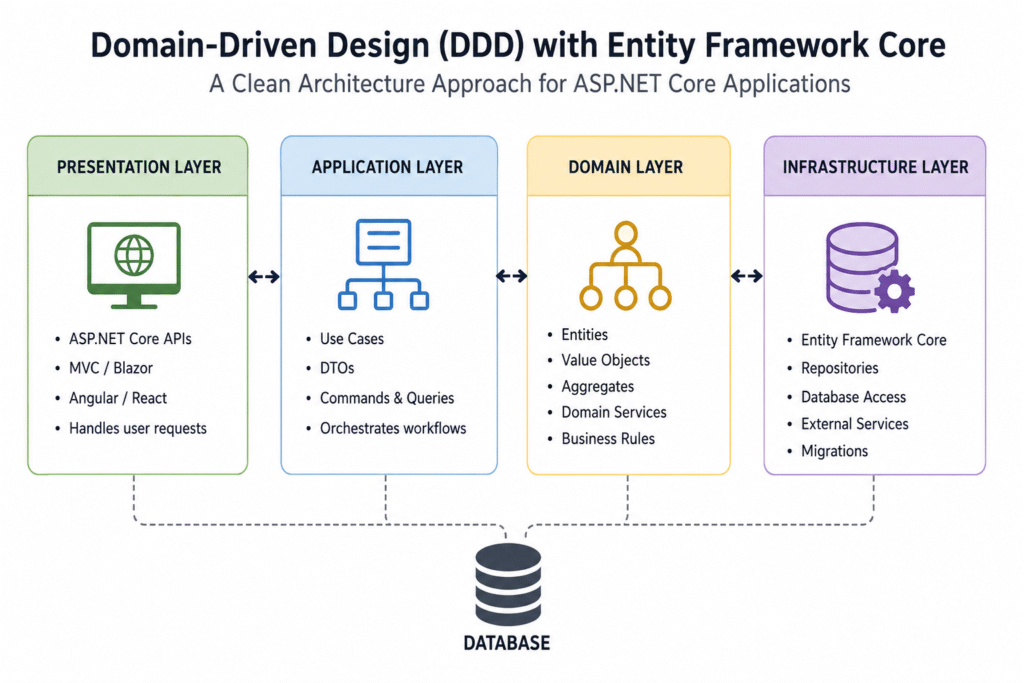
Domain-Driven Design with Entity Framework Core Architecture
A clean DDD architecture usually consists of four major layers.
Domain Layer
The Domain Layer contains:
- Entities
- Value Objects
- Aggregates
- Domain Services
- Business rules
This is the heart of the application.
Application Layer
The Application Layer handles:
- Use cases
- DTOs
- Commands
- Queries
- Workflow orchestration
It acts as a bridge between the domain and presentation layers.
Infrastructure Layer
The Infrastructure Layer manages technical concerns such as:
- Entity Framework Core
- Database access
- External APIs
- Authentication
- Messaging systems
EF Core configurations typically belong here.
Presentation Layer
The Presentation Layer includes:
- ASP.NET Core APIs
- MVC applications
- Blazor applications
- Angular frontends
- React frontends
This layer interacts with users and external clients.
Best Practices for Domain-Driven Design with Entity Framework Core
Following proper DDD practices improves scalability and maintainability.
Keep Domain Models Independent
Avoid coupling domain entities directly with EF Core annotations and database logic.
Use Rich Domain Models
Business logic should live inside entities rather than service classes whenever possible.
Use Fluent API Configurations
Fluent API keeps EF Core configurations separated from domain logic, resulting in cleaner architecture.
Protect Business Rules Inside Entities
Entities should enforce validation and business invariants internally.
Avoid Excessive Generic Repositories
Overusing generic repositories often creates unnecessary abstraction and weakens domain logic.
Use Domain Events
Domain events improve scalability and support loosely coupled workflows in enterprise systems.
Benefits of Combining Domain-Driven Design with Entity Framework Core
Using Domain-Driven Design with Entity Framework Core provides several advantages for enterprise development.
Major Advantages
- Scalable enterprise applications
- Cleaner software architecture
- Better collaboration with business teams
- Easier testing and debugging
- Improved maintainability
- Flexible long-term system evolution
DDD is especially valuable for complex ASP.NET Core applications with evolving business requirements.
Challenges of Domain-Driven Design
Despite its advantages, DDD is not suitable for every project.
Common Challenges
- Higher learning curve
- Increased architectural complexity
- Longer initial development time
- Requires strong domain understanding
For small CRUD applications, simpler architectures may be more practical.
Using DDD unnecessarily can overcomplicate simple systems.
Conclusion
Domain-Driven Design with Entity Framework Core provides a powerful strategy for building scalable, maintainable, and business-focused ASP.NET Core applications.
By separating business logic from infrastructure concerns, developers can create cleaner architectures that adapt easily to changing requirements.
For developers working with ASP.NET Core and EF Core, learning Domain-Driven Design can significantly improve software architecture, code quality, and long-term maintainability.