AI Agent Technology is emerging as an important development in artificial intelligence, enabling intelligent AI systems to move beyond generating responses and perform multi-step tasks. By combining reasoning, planning, tool integration, and feedback, AI agents can work towards specific goals with varying levels of autonomy.
Traditional AI applications often focus on answering questions, recognising patterns, or generating content. Agentic AI can take this further by deciding which steps to perform, interacting with connected tools, evaluating results, and adjusting its approach when necessary.
From business operations and software development to customer service and research, Agentic AI is creating new opportunities to build more adaptive and intelligent applications.
Understanding how these systems work can help students, developers, and businesses prepare for the next stage of AI innovation.
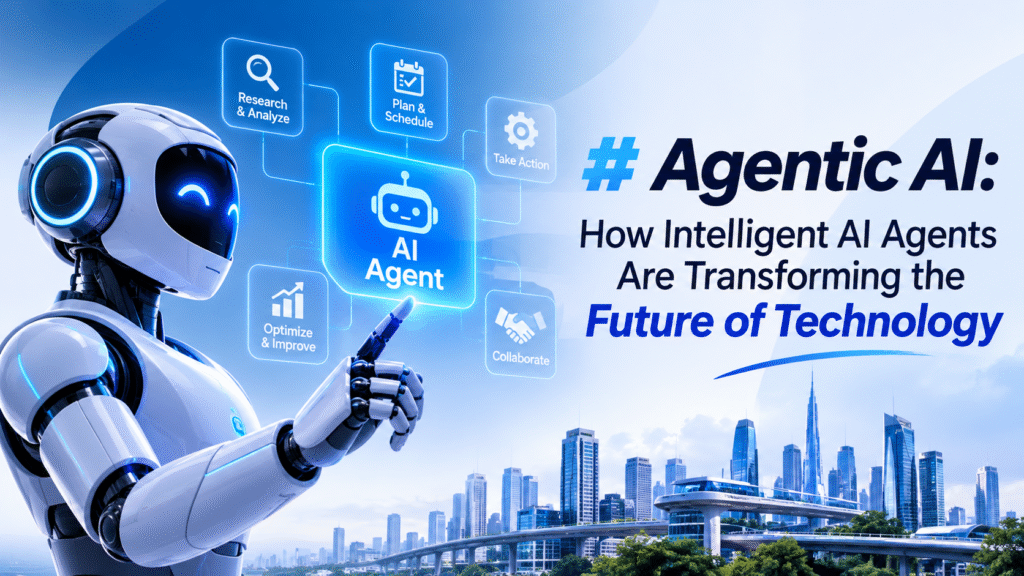
What Makes AI Agent Technology Different?
Agentic AI is not simply another chatbot or content-generation tool. Its defining characteristic is the ability to work towards an objective through a sequence of decisions and actions.
For example, a conventional AI assistant might explain how to prepare a project report. An Agentic AI system could help gather information, organise the findings, prepare a draft, check the content, and present the completed report using its available tools.
The actual capabilities depend on the model, connected applications, permissions, and workflow design.
Important characteristics include:
- Goal-oriented behaviour: Works towards a defined outcome.
- Planning: Breaks complex objectives into smaller tasks.
- Tool integration: Interacts with approved APIs, databases, and applications.
- Context awareness: Uses relevant information to guide its actions.
- Feedback and evaluation: Checks results and determines what to do next.
- Controlled autonomy: Performs permitted actions within defined boundaries.
How AI Agent Technology Works
Agentic AI systems typically operate through an iterative process rather than producing only one response.
Step 1: How AI Agents Understand Goals
The system receives an instruction, identifies the intended outcome, and gathers relevant context.
Step 2: AI Agent Planning and Decision-Making
It determines the actions needed to achieve the goal and organises them into manageable steps.
Step 3: How AI Agents Select Tools
The agent identifies which available tools, APIs, or information sources can help complete each task.
Step 4: AI Agent Execution and Actions
Within its configured permissions, the agent performs actions such as retrieving information, analysing documents, running code, or updating an application.
Step 5: Evaluating AI Agent Results
The system checks the results against the task requirements and identifies incomplete steps or potential errors.
Step 6: AI Agent Feedback and Continuous Improvement
The agent may perform another action, revise its plan, return the result, or request human assistance when necessary.
This process is often called an agent loop. The number of steps and the level of autonomy vary according to the application.
Agentic AI vs Generative AI: Key Differences
Generative AI and Agentic AI are closely related, but they serve different purposes.
| Feature | Generative AI | Agentic AI |
|---|---|---|
| Primary purpose | Generate content or outputs | Work towards a defined goal |
| Typical interaction | Responds to a prompt | Coordinates multiple steps |
| Tool usage | May use connected tools | Uses tools as part of a goal-oriented workflow |
| Adaptation | Depends on the application | Can evaluate progress and adjust actions |
| Example | Generates a software function | Helps implement and test a software feature |
Generative AI can provide the underlying model used by an agent. Agentic AI combines model capabilities with planning, tools, context, and execution controls.
Real-World Applications of AI Agent Technology
1. Software Development
Agentic AI can assist developers with analysing requirements, generating code, reviewing existing files, preparing tests, and debugging errors.
For example, an AI agent working on a registration feature might inspect the relevant project files, suggest implementation changes, run available tests, and report any failures for developer review.
2. Business Process Automation
Businesses handle many repetitive workflows involving information collection, document processing, reporting, and task coordination.
Agentic AI can connect these activities and help manage multi-step processes. Organisations should define clear permissions and approval requirements before allowing agents to make changes to business systems.
3. Customer Support
AI agents can classify customer requests, retrieve information from approved knowledge bases, prepare responses, and route complicated cases to the appropriate support team.
This can help support teams handle routine requests while retaining human assistance for sensitive or unusual situations.
4. Digital Marketing
Agentic AI can support marketing research, content planning, keyword analysis, campaign reporting, and performance monitoring.
For example, an agent could collect campaign metrics, identify changes in performance, prepare recommendations, and request approval before making significant campaign adjustments.
5. Education and Learning
AI agents can help learners access educational resources, practise technical concepts, receive feedback, and organise study plans.
Educators can also explore agent-based tools for preparing learning materials and supporting administrative workflows.
6. Data Analysis and Research
Research agents can collect information from permitted sources, organise datasets, compare findings, and prepare summaries.
The quality of the final output depends on the reliability of the source data and the effectiveness of verification procedures.
Benefits of AI Agent Technology
Improved Productivity
Agents can help reduce repetitive work and support workflows that require several connected actions.
Better Workflow Coordination
By coordinating tasks across approved applications, Agentic AI can reduce the need for manual handoffs between individual workflow stages.
Faster Information Processing
Agents can help collect and organise information from multiple sources, making it easier for people to review relevant findings.
Support for Complex Tasks
Tasks can be divided into smaller steps, allowing the system to handle different parts of a workflow in an organised manner.
Greater Operational Flexibility
Some agentic systems can adapt their next steps when new information becomes available or an expected action fails.
These benefits are not automatic. They depend on implementation quality, suitable use cases, monitoring, and measurable performance improvements.
Challenges and Risks of AI Agent Technology
Despite its potential, Agentic AI introduces important technical and operational challenges.
Accuracy: Agents can misunderstand instructions or produce incorrect results.
Security: Access to applications and external tools can create risks if permissions are too broad.
Privacy: Sensitive information must be handled according to appropriate data protection requirements.
Unintended actions: An agent may perform an action that does not match the user’s actual intention.
Cost and performance: Complex workflows can involve multiple model calls and additional processing costs.
Accountability: Organisations need clear responsibility for decisions, actions, and outcomes.
To address these challenges, developers should use restricted permissions, reliable testing, execution logs, monitoring, and human approval for important or difficult-to-reverse actions.
Essential Technologies Used in Agentic AI Development
Building Agentic AI applications involves several complementary technologies.
Large Language Models for Agentic AI
LLMs provide language understanding, reasoning-related capabilities, and response generation for many agentic applications.
APIs and Tool Integration in Agentic AI
APIs allow agents to interact with external services, databases, and software applications.
RAG in AI Agent Development
RAG enables an application to retrieve relevant information from a knowledge source and provide it as context to an AI model.
Memory Management in Agentic AI
Memory and context mechanisms help systems retain relevant information during a task or across supported sessions.
Popular AI Agent Development Frameworks
Frameworks such as LangChain, LangGraph, CrewAI, and Microsoft Semantic Kernel provide tools and patterns for developing AI applications and agent workflows.
Monitoring and Evaluating AI Agents
Evaluation tools help developers assess accuracy, task completion, performance, cost, and compliance with system requirements.
No single technology creates a complete Agentic AI system. Effective applications combine suitable models, data, tools, orchestration, and safeguards.
Essential Skills for AI Agent Technology
Students and professionals interested in Agentic AI can begin by developing a strong technical foundation.
Key skills include:
- Python programming
- JavaScript and web development fundamentals
- Artificial intelligence and machine learning concepts
- Generative AI and Large Language Models
- Prompt engineering
- API development and integration
- Database management
- Retrieval-Augmented Generation
- AI agent frameworks
- Workflow orchestration
- Cloud deployment and application security
Practical projects help learners understand how these technologies work together in real applications.
Career Opportunities in AI Agent Development
As organisations explore AI-powered applications and automation, several related technical roles may offer opportunities for skilled professionals.
AI Engineer Career Opportunities
Develops and integrates AI capabilities into applications and business systems.
AI Agent Developer Career Path
Builds applications that use AI agents, tools, APIs, and multi-step workflows.
Generative AI Development Careers
Creates applications powered by generative models and related technologies.
AI Automation Engineer Career Path
Designs workflows that combine AI capabilities with software integrations and business processes.
Machine Learning Careers in AI
Develops, evaluates, and deploys machine learning systems.
AI Application Development Careers
Builds user-facing software applications that integrate AI features.
The skills and qualifications required vary by role. Strong programming fundamentals, practical experience, and an understanding of AI limitations can help learners prepare for these career paths.
How to Get Started with AI Agent Technology
If you are new to this field, follow a practical learning path.
- Learn programming: Start with Python or another suitable programming language.
- Understand APIs: Learn how applications exchange data and invoke services.
- Explore Generative AI: Understand LLMs, prompting, and model limitations.
- Build a basic AI application: Create a simple chatbot or document-question-answering tool.
- Learn agent workflows: Explore tool calling, planning, state management, and evaluation.
- Develop a practical project: Build a research assistant, document analyser, or customer support prototype.
- Test and improve: Evaluate accuracy, reliability, security, and cost before expanding the application.
Start with a small, controlled project before introducing complex workflows or granting access to important systems.
The Future of Agentic AI Technology
Agentic AI is developing rapidly as AI models, software integrations, and agent frameworks improve. Future applications may coordinate more complex workflows, interact with a wider range of business tools, and provide more specialised assistance.
However, progress will depend on more than model capability. Reliable execution, clear permissions, effective evaluation, privacy protection, and human oversight will remain essential.
For developers, the opportunity lies in understanding how to build useful AI systems that solve real problems rather than relying on automation alone.