Artificial Intelligence is transforming the digital world at an incredible pace. From generating human-like conversations to creating images, writing software code, and analyzing information, AI technologies are becoming part of everyday life. Understanding Agentic AI vs Generative AI is becoming increasingly important as these technologies reshape how businesses and developers use artificial intelligence.
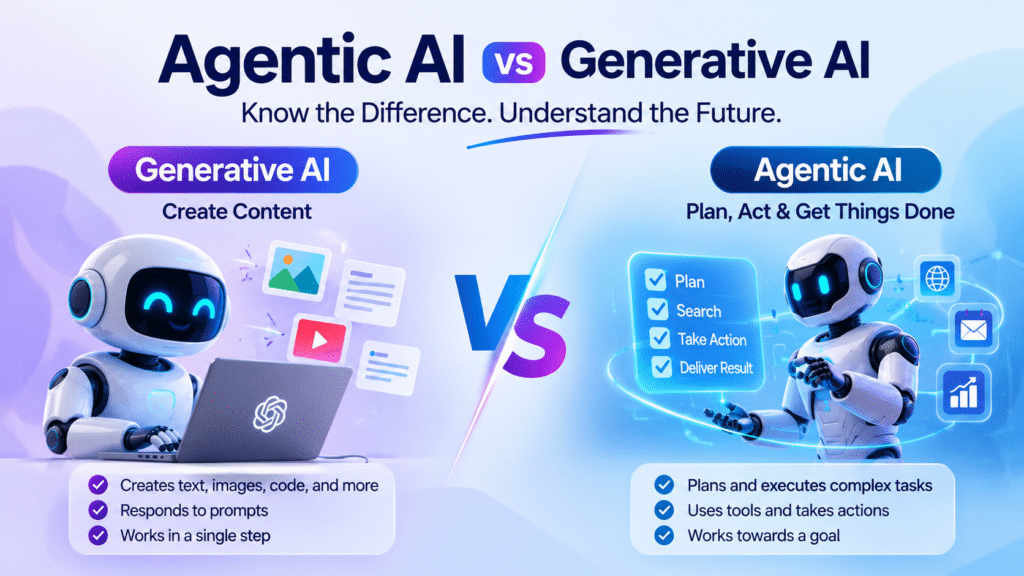
This development is known as Agentic AI.
While Generative AI has changed how people create and interact with digital content, Agentic AI is introducing new ways to automate workflows and solve complex problems.
But what is the difference between these technologies? How do they work together? And why should developers and businesses understand them?
Let’s explore.
What Is Generative AI?
Generative AI is a branch of artificial intelligence that focuses on creating new content based on patterns learned from training data.
It can generate different types of content, including:
- Text and articles.
- Images and illustrations.
- Computer programming code.
- Audio and speech.
- Videos and creative content.
- Summaries and reports.
Popular applications of Generative AI allow users to interact with AI models through natural language instructions.
For example, a developer can ask a Generative AI tool to write a Python function, explain a programming concept, or suggest improvements to existing code.
Generative AI makes content creation and information processing faster, but generating an answer does not necessarily mean completing an entire task.
What Is Agentic AI?
Understanding Agentic AI vs Generative AI starts with recognizing how these technologies perform different functions. While Generative AI focuses on creating content based on user prompts, Agentic AI focuses on planning tasks, making decisions, and executing actions through connected tools.
Agentic AI vs Generative AI: Key Differences
The key difference between Agentic AI vs Generative AI is their approach to completing tasks. Generative AI produces content such as text, images, and code, whereas Agentic AI can coordinate multiple actions to achieve a specific objective. Both technologies can work together to develop intelligent applications.
| Feature | Generative AI | Agentic AI |
|---|---|---|
| Main purpose | Content generation | Goal-oriented task execution |
| Primary function | Creates responses and content | Plans and performs actions |
| Tool usage | May use connected tools | Often relies on tools and integrations |
| Workflow | Usually prompt-driven | Can involve multiple coordinated steps |
| Adaptability | Generates content based on context | Can adjust actions based on results |
| Applications | Writing, coding, images | Automation, research, complex workflows |
One important point is that Agentic AI can use Generative AI models as its reasoning and language-processing component.
In other words, these technologies are not competitors. They can work together to create more capable AI applications.
How Do Agentic AI Systems Work?
An Agentic AI system combines several components to complete a specific objective.
1. Goal Understanding
The agent receives an instruction and identifies what the user wants to accomplish.
2. Planning and Reasoning
It breaks the objective into smaller tasks and determines which actions are required.
3. Tool Selection
The agent identifies suitable tools, APIs, databases, or external services needed to complete the task.
4. Task Execution
It performs the selected actions using its available permissions and integrations.
5. Feedback and Evaluation
The agent checks the results, identifies potential problems, and determines whether further actions are necessary.
This cycle enables AI agents to manage workflows involving multiple connected tasks.
Practical Examples of Agentic AI and Generative AI Working Together
When comparing Agentic AI vs Generative AI in real-world applications, software development provides a useful example. Generative AI can suggest and generate programming code, while an AI agent can coordinate coding, testing, debugging, and documentation workflows with appropriate developer supervision.
1. Intelligent Software Development
Generative AI can assist developers by writing code, explaining functions, and generating documentation.
Agentic AI can coordinate a broader development workflow by assisting with requirement analysis, code generation, testing, debugging, and review.
For example, specialized agents can support different stages of software development while developers supervise the final output.
2. AI-Powered Digital Marketing
Generative AI can create advertising copy, social media captions, and blog content.
Agentic AI can coordinate marketing activities by researching keywords, analyzing campaign data, organizing content plans, and preparing performance reports.
This can help marketing teams manage multiple activities more efficiently.
3. Automated Customer Support
Generative AI can create natural-language responses to customer questions.
Agentic AI can retrieve information from connected systems, identify the type of request, guide customers through approved processes, and escalate complicated issues to human professionals.
4. Business Research and Reporting
Generative AI can summarize information and prepare reports.
Agentic AI can collect information from different approved sources, analyze the findings, and coordinate the preparation of a complete report.
5. Personal Productivity Assistants
Generative AI can help draft emails, organize ideas, and summarize documents.
An AI agent can go further by coordinating connected applications to manage permitted tasks, such as organizing information and preparing calendar updates for approval.
The Role of Large Language Models in Agentic AI
Large Language Models (LLMs) are an important part of many modern Agentic AI systems.
They help AI agents understand natural language instructions, interpret context, generate plans, and decide which tools may be useful.
However, an LLM alone does not automatically become a complete AI agent.
A functional agent generally requires additional components such as:
- Tool integrations.
- Memory and context management.
- Planning and orchestration.
- Execution mechanisms.
- Feedback and evaluation.
- Security and permission controls.
Combining these components allows developers to create AI systems that can interact with external applications and perform multi-step tasks.
Important Technologies Used to Build Agentic AI Applications
Developers interested in building intelligent AI applications should understand several important technologies.
Python Programming: Python is widely used in AI development, machine learning, automation, and application integration.
Large Language Models: LLMs provide the language understanding and generation capabilities used by many AI agents.
Agent Frameworks: Tools such as LangGraph help developers create structured agent workflows and coordinate multiple steps.
APIs and Function Calling: These enable AI systems to communicate with external applications and execute specific operations.
Model Context Protocol (MCP): MCP provides a standardized way for AI applications to connect with external tools and data sources.
Retrieval-Augmented Generation (RAG): RAG allows AI applications to retrieve relevant information from external knowledge sources.
Cloud Computing: Cloud platforms support the deployment, monitoring, and scaling of AI applications.
Understanding these technologies can help learners progress from using AI tools to developing their own intelligent solutions.
Can Agentic AI Replace Traditional Software Development?
Agentic AI is changing software development, but it does not remove the importance of software engineering fundamentals.
AI agents can help developers write code, generate tests, identify errors, and automate repetitive activities.
However, building reliable applications still requires human expertise in:
- Software architecture.
- Database design.
- Programming logic.
- Application security.
- System integration.
- Performance optimization.
- Testing and quality assurance.
The future of software development will likely involve greater collaboration between developers and AI-powered tools.
Professionals who understand both software engineering and AI technologies can be better prepared to work with these evolving development practices.
Career Opportunities in Generative AI and Agentic AI
As organizations explore AI-powered applications, technical professionals with relevant skills can pursue different career paths.
Some potential opportunities include:
- AI Engineer.
- Agentic AI Developer.
- Generative AI Developer.
- Python Developer.
- AI Automation Engineer.
- Machine Learning Engineer.
- AI Application Developer.
To build a foundation for these roles, learners should understand programming, AI fundamentals, APIs, LLMs, databases, and practical application development.
Working on real-world projects is particularly useful for understanding how these technologies are implemented.
Learn the Technologies Behind the Future of AI at Aitrich Academy
Artificial Intelligence is creating new possibilities for software development and digital innovation.
At Aitrich Academy, learners can explore modern software development and AI technologies through practical learning and real-world project exposure.
Developing programming skills, understanding AI concepts, and working on practical applications can help aspiring professionals build the technical foundation needed for the evolving IT industry.
Whether you are a fresher, a student, or someone planning to expand your software development skills, exploring emerging AI technologies can be a valuable step towards your professional future.
Don’t just use AI. Learn how to build intelligent applications with AI.
Explore learning opportunities at https://aitrichacademy.com/
Conclusion
Understanding Agentic AI vs Generative AI helps developers and businesses identify the right technology for different requirements. As artificial intelligence continues to evolve, combining content generation with intelligent task execution can create more powerful and practical AI solutions.