The digital world is growing rapidly, and businesses today need powerful web applications to serve customers efficiently. From startups to multinational companies, organizations are actively seeking professionals who can manage both front-end and back-end development. This is where a Full Stack Developer plays a crucial role.
A full stack developer is one of the most versatile professionals in the software industry. They possess the skills to build complete web applications, handle databases, manage servers, and create user-friendly interfaces. Due to their broad expertise, full stack developers are among the most in-demand professionals in the technology sector.
In this blog, we will explore who a full stack developer is, their responsibilities, required skills, career opportunities, and future scope.
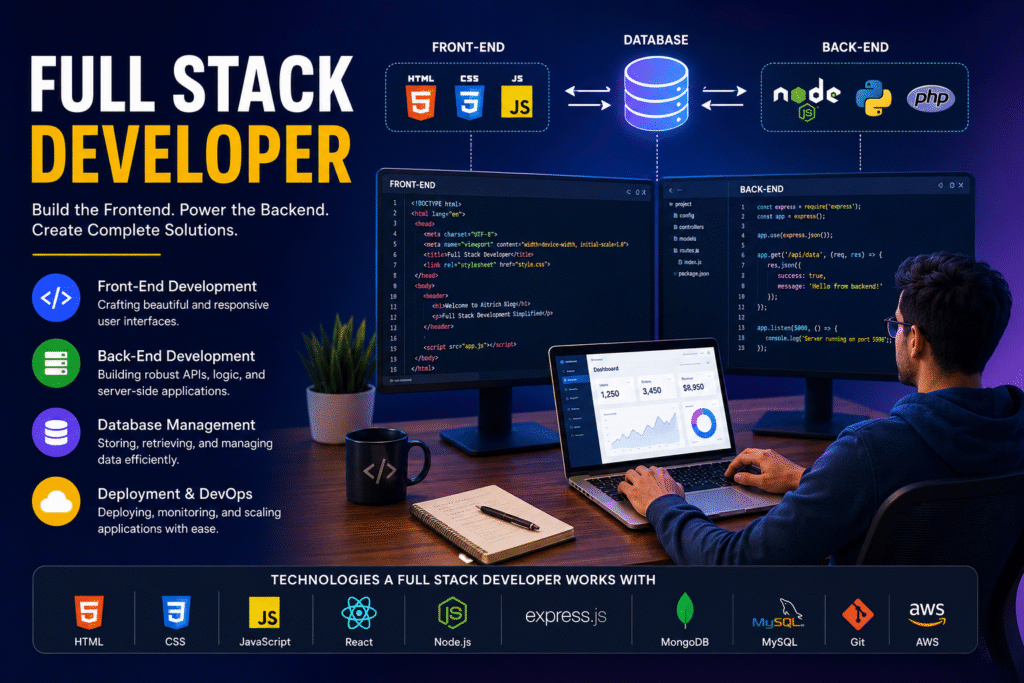
Who is a Full Stack Developer?
A Full Stack Developer is a software professional capable of working on both the client side (front end) and server side (back end) of an application. They understand the entire development lifecycle and can build complete applications from start to finish.
A full stack developer works with:
- User Interface (UI)
- Front-end technologies
- Back-end programming
- Databases
- APIs
- Server management
- Deployment and maintenance
Because of their ability to work across multiple layers of an application, they are highly valuable to organizations.
Front-End Development
Front-end development focuses on what users see and interact with on a website or application.
Key Front-End Technologies
HTML
HTML provides the structure of web pages.
CSS
CSS is used for styling and designing websites.
JavaScript
JavaScript adds interactivity and dynamic functionality.
Front-End Frameworks
Popular frameworks include:
- React.js
- Angular
- Vue.js
These frameworks help developers build fast and responsive applications.
Back-End Development
Back-end development manages the server, application logic, and database operations.
Popular Back-End Languages
- Java
- Python
- PHP
- JavaScript (Node.js)
- C#
- Ruby
Back-end developers ensure that data processing and business logic work smoothly behind the scenes.
Database Management
Databases store and organize application data efficiently.
Common Databases Used by Full Stack Developers
SQL Databases
- MySQL
- PostgreSQL
NoSQL Databases
- MongoDB
- Firebase
Knowledge of databases helps developers create scalable and secure applications.
Essential Skills Required for a Full Stack Developer
To become a successful full stack developer, one must master both technical and soft skills.
Technical Skills
1. Programming Languages
A strong understanding of programming languages is essential.
2. Frameworks and Libraries
Developers should be familiar with modern frameworks for faster development.
3. API Development
Knowledge of REST APIs and GraphQL is highly beneficial.
4. Version Control
Tools like Git and GitHub help manage code efficiently.
5. Cloud Platforms
Understanding cloud services such as AWS, Azure, or Google Cloud is increasingly important.
Soft Skills
- Problem-solving ability
- Communication skills
- Team collaboration
- Time management
- Continuous learning mindset
Roles and Responsibilities of a Full Stack Developer
A full stack developer performs multiple tasks throughout the software development lifecycle.
Their responsibilities include:
- Designing user interfaces
- Developing server-side applications
- Managing databases
- Integrating APIs
- Debugging and testing software
- Deploying applications
- Maintaining system security
- Optimizing website performance
Their broad skill set allows organizations to reduce development costs and improve efficiency.
Why Are Full Stack Developers in High Demand?
Businesses prefer hiring professionals who can handle multiple aspects of development. A full stack developer can work on different layers of a project, reducing dependency on separate teams.
Reasons for High Demand
- Cost-effective hiring
- Faster project delivery
- Better collaboration
- Greater flexibility
- Improved problem-solving
As digital transformation accelerates globally, the demand for skilled full stack developers continues to rise.
Career Opportunities for Full Stack Developers
A career in full stack development offers numerous opportunities across industries.
Popular Job Roles
- Full Stack Developer
- Software Engineer
- Web Developer
- Application Developer
- Technical Lead
- Solutions Architect
- DevOps Engineer
Industries hiring full stack developers include:
- IT Services
- E-commerce
- Healthcare
- Banking
- Education Technology
- Digital Marketing
- Startups
Salary of a Full Stack Developer
The salary of a full stack developer depends on skills, experience, and location.
Average Salary Range
- Freshers: Competitive entry-level packages
- Mid-Level Professionals: Higher growth opportunities
- Experienced Developers: Premium salary packages
Professionals with expertise in modern technologies often receive attractive compensation and global opportunities.
Future Scope of Full Stack Development
The future of full stack development looks highly promising. Emerging technologies such as Artificial Intelligence, Cloud Computing, and Internet of Things (IoT) are creating new opportunities for developers.
Companies increasingly seek professionals who can adapt quickly and manage end-to-end development processes.
With continuous learning and upskilling, full stack developers can build rewarding careers in the global technology landscape.
How to Become a Full Stack Developer?
Follow these steps to start your journey:
- Learn HTML, CSS, and JavaScript.
- Master a front-end framework like React.
- Learn back-end technologies such as Node.js or Python.
- Understand databases like MySQL and MongoDB.
- Practice Git and GitHub.
- Build real-world projects.
- Learn deployment and cloud technologies.
- Continuously update your skills.
Practical experience through internships and projects significantly improves employability.
Conclusion
This is the one of the most valuable professionals in today’s technology-driven world. Their ability to handle both front-end and back-end development makes them indispensable for organizations of all sizes.
As businesses continue their digital transformation journey, the demand for skilled full stack developers is expected to grow even further. Whether you are a student, fresher, or working professional, learning full stack development can open doors to exciting career opportunities and long-term growth.
Invest in learning, practice consistently, and stay updated with emerging technologies to build a successful career as a full stack developer.