
Ten years ago, learning a Python data science course was like trying to find your way in the dark. There were some textbooks and a few incomplete web guides or video talks, but they didn’t explain much. People spent hours fixing small mistakes, getting frustrated, and many gave up, not because they couldn’t learn, but because it was exhausting. Progress was slow, and the old system couldn’t keep up with how fast things move now. For those beginning to learn Python, exploring a beginner-friendly Python roadmap can significantly reduce initial challenges and frustration.
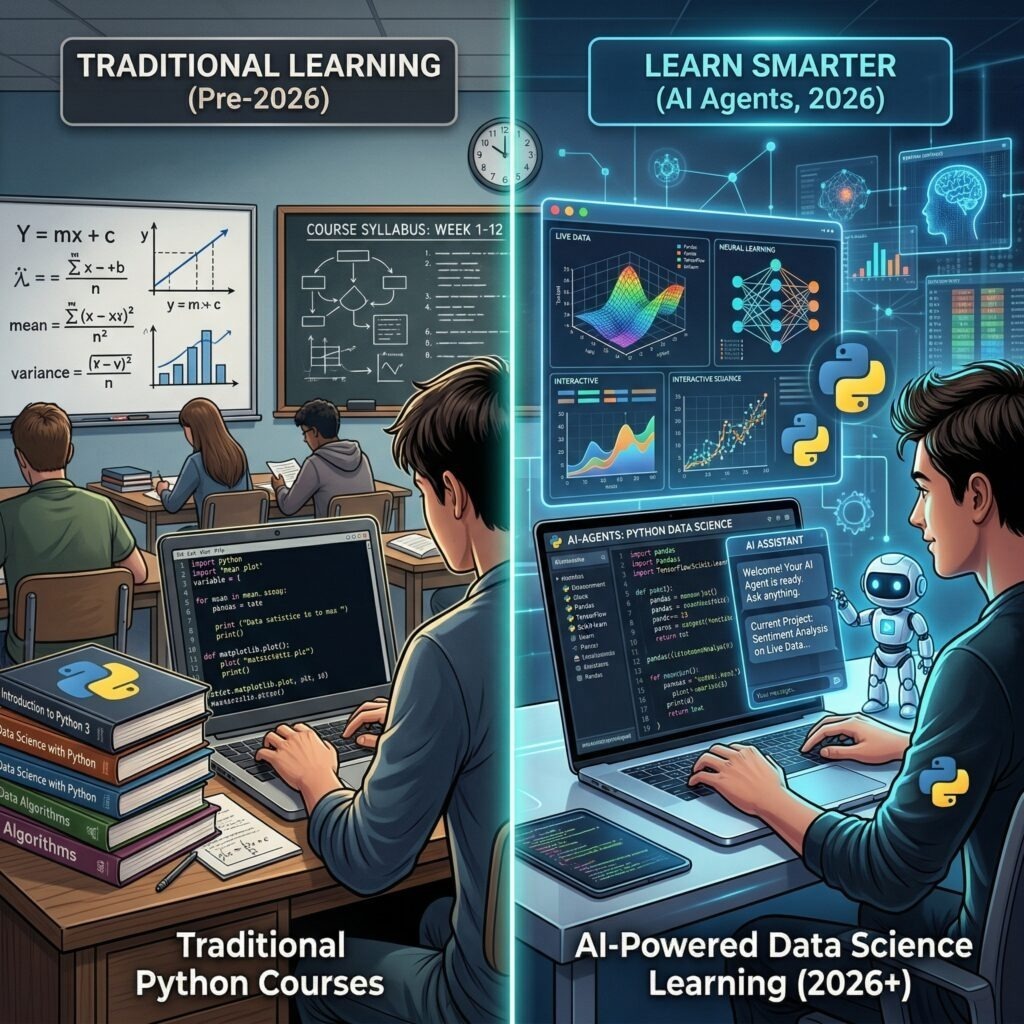
Now, in 2026, how people learn has changed a lot. AI helpers built into Python data science courses have flipped the way teaching works. Instead of just watching videos or reading through materials, students interact with smart programs that guide them step by step. These digital helpers are available all the time, don’t get frustrated, and often understand where you’re stuck before you even say it.
What makes this shift powerful is turning fixed lessons into something more flexible and responsive. The system watches what you do, notices where you struggle, and adjusts the lesson on the spot. If you get stuck on pandas, it immediately reacts. If you breeze through NumPy, the lesson changes to keep up with you. This kind of personalized support just wasn’t around in traditional classrooms.
Something subtle is happening inside learners’ minds. They’re not facing problems alone anymore because answers come quickly thanks to those smart helpers. The moments of being stuck don’t last as long. It feels like someone experienced is there, ready to give you a little nudge right when you need it.
Python Data Science Course:Why 2026 Marks a Turning Point?
By 2026, it will be evident that learning aided by artificial intelligence is no longer an exception. Several factors contribute to this shift. Advances in natural language processing improve the ability of machines to comprehend human speech, while the integration of AI into programming environments enhances usability and adoption. The combination of these developments makes AI-assisted learning increasingly accessible and effective.
A significant driver of this trend concerns accessibility. Previously, acquiring substantial data science skills often required enrolling in costly bootcamps or obtaining formal degrees. Currently, AI-powered tools offer more affordable, customized educational experiences. According to the WEF, over two-thirds of online learners utilized AI assistance during their studies in the past year, with projections suggesting this proportion may approach four-fifths in the near future.
Efficiency also plays a crucial role. Given limited time, AI support helps learners optimize their study sessions by providing immediate solutions tailored to their specific problems, reducing time spent on troubleshooting or searching through forums. Consequently, learners tend to advance more rapidly, which accelerates the transition from novice to proficient practitioner.
These developments reflect broader changes in professional practice. Familiarity with AI tools increasingly complements traditional coding skills, reshaping the competencies required in the workforce. Engaging with programming languages such as Python in conjunction with AI agents exemplifies a collaborative dynamic between humans and machines that is becoming central to contemporary work environments.
What Is a Python Data Science Course with AI Agents?
Understanding AI Agents in Learning
- Functions as an intelligent entity, not just a predefined assistant or responder
- Interprets context, observes user behavior, and provides relevant guidance
- Combines instructional support, coding help, and career guidance seamlessly
- Operates like a panel of experts that evaluates before responding
- In a Python data science course, it plays multiple roles:
- Explains complex concepts clearly
- Provides executable code snippets when needed
- Simulates real-world scenarios
- Adapts to learner proficiency:
- Beginners receive simple explanations
- Advanced users get in-depth insights
- Supports a reciprocal learning process:
- Continuously monitors user progress
- Analyzes mistakes without interrupting the flow
- Gradually improves guidance based on interactions
- Evolves autonomously through iterative adjustments without direct intervention
- Enhances the experience of a Python Data Science Course through smart assistance and personalization
- Enables a modern learning approach:
- Users ask questions instead of searching traditionally
- Delivers fast, context-aware responses
- Reduces unnecessary navigation and keeps focus on learning
Core Components of the Course
- An interactive workspace allows direct Python coding with real-time output
- Intelligent assistants provide subtle suggestions and corrections while typing
- Seamless integration of tools creates a smooth, distraction-free workflow
- Immediate results enable continuous coding and evaluation within one interface
- Built-in guidance proactively prevents errors without interrupting the user
- Course structure is organized yet flexible:
- Covers topics from basic Python to advanced machine learning
- Adapts speed and sequence based on individual learner performance
- Encourages practical application like multi-agent systems and GenAI projects
- Strong focus on experiential learning:
- Hands-on tasks such as data analysis, predictive modeling, and visualization
- A real-world problem-solving approach enhances understanding
- Learning is driven by active practice rather than passive theory
- Continuous evaluation approach:
- Ongoing feedback instead of only final assessments
- Identifies weak areas and provides targeted improvement suggestions
- Personalized exercises help strengthen specific skills
- Career-oriented support:
- Resume building assistance
- Interview preparation and simulations
- Portfolio development for job readiness
Why Python Remains the King of Data Science?
Simplicity Meets Power
Python occupies a prominent position in data science primarily due to its balanced combination of accessibility and functionality. Beginners often find the language approachable from the outset. Its syntax is both clean and intuitive, resembling natural language to a degree that facilitates rapid comprehension and ease of use. This design reduces initial barriers, allowing users to focus on problem-solving rather than grappling with complex rules.
Despite its apparent simplicity, Python conceals considerable capabilities beneath its user-friendly surface. It efficiently handles a range of tasks, from managing basic datasets to executing sophisticated artificial intelligence algorithms. This versatility accounts for its widespread adoption among novices and experienced practitioners alike.
Python integrates effectively with AI-driven educational environments, owing in part to its straightforward syntax. This clarity enables automated systems to generate, assess, and refine code with relative ease. Whether crafting simple scripts or developing intricate models, the language accommodates increasing levels of complexity while maintaining manageable adjustments and iterations.
A significant advantage stems from the extensive community support surrounding Python. A vast number of programmers contribute to a rich pool of resources, including online forums, tutorials, and collaborative platforms. Consequently, obstacles encountered during development are typically resolved promptly, even in solitary settings. When combined with intelligent programming aids, this support network fosters continuous, steady advancement, reinforcing the learning process through readily available assistance.
Libraries That Drive Innovation
Python’s real value comes not just from its simple syntax but from its powerful ecosystem of libraries. Tools like NumPy enable fast numerical calculations, Pandas simplifies data cleaning and organization, and matplotlib helps create clear visualizations. Additionally, scikit-learn makes machine learning easier by handling much of the underlying complexity, allowing users to solve complex problems with concise code.
Pandas, for example, helps convert messy datasets into structured formats that are easier to work with. Visualization libraries like matplotlib and Seaborn make it simple to identify patterns and insights from data. At the same time, scikit-learn automates many steps involved in building predictive models, reducing manual effort.
When dealing with complex datasets, a smart assistant can guide users by suggesting the right tools and explaining their purpose in simple terms. This reduces guesswork, speeds up the workflow, and supports learning through practical use, helping users build understanding naturally.
With advanced frameworks like TensorFlow and PyTorch, Python also supports deep learning and AI development. As intelligent technologies become more common across industries, knowing how to use these tools becomes essential for collaboration and real.