Introduction
Evolution of Java is one of the most remarkable stories in software development. Since its first release in 1996, Java has continuously evolved by introducing new features, improving performance, and adapting to modern development needs. Today, Java remains a leading programming language for enterprise, web, mobile, and cloud applications.
JDK 1.0: The Beginning of Java
Released in 1996 by Sun Microsystems, JDK 1.0 introduced Java’s famous “Write Once, Run Anywhere” concept through the Java Virtual Machine (JVM).
Key Features
- Applets
- AWT
- Security framework
- Networking APIs
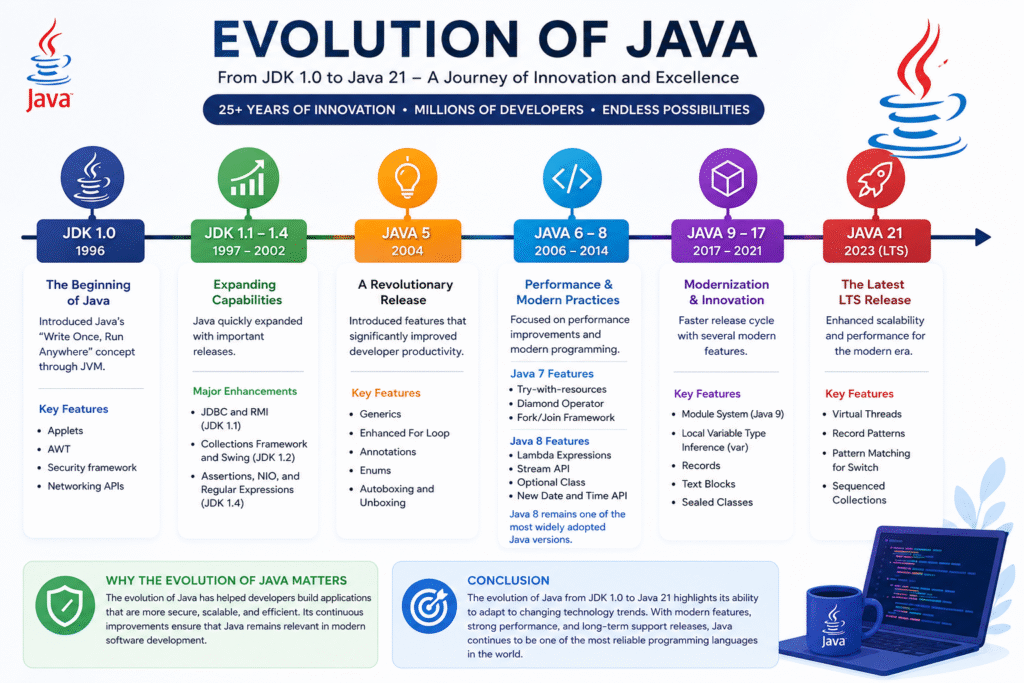
Evolution of Java: JDK 1.1 to JDK 1.4
Java quickly expanded its capabilities with several important releases.
Major Enhancements
- JDBC and RMI (JDK 1.1)
- Collections Framework and Swing (JDK 1.2)
- Assertions, NIO, and Regular Expressions (JDK 1.4)
Java 5: A Revolutionary Release
Java 5 introduced features that significantly improved developer productivity.
Key Features
- Generics
- Enhanced For Loop
- Annotations
- Enums
- Autoboxing and Unboxing
Evolution of Java: Java 6 to Java 8
This period focused on performance improvements and modern programming practices.
Features of Java 7
- Try-with-resources
- Diamond Operator
- Fork/Join Framework
Java 8 Features
- Lambda Expressions
- Stream API
- Optional Class
- New Date and Time API
Java 8 remains one of the most widely adopted Java versions.
Evolution of Java: Java 9 to Java 17
Java adopted a faster release cycle and introduced several modern features.
Key Features
- Module System (Java 9)
- Local Variable Type Inference (var)
- Records
- Text Blocks
- Sealed Classes
Java 21: The Latest LTS Release
Java 21 continues the evolution of Java with enhanced scalability and performance.
Key Features
- Virtual Threads
- Record Patterns
- Pattern Matching for Switch
- Sequenced Collections
Why the Evolution of Java Matters
The evolution of Java has helped developers build applications that are more secure, scalable, and efficient. Its continuous improvements ensure that Java remains relevant in modern software development.
Conclusion
The evolution of Java from JDK 1.0 to Java 21 highlights its ability to adapt to changing technology trends. With modern features, strong performance, and long-term support releases, Java continues to be one of the most reliable programming languages in the world.