Introduction
Explainable AI is transforming modern applications across industries. From recommendation systems and fraud detection to healthcare diagnostics and predictive analytics, AI is becoming an essential part of business operations.
However, as machine learning models become more advanced, understanding how they make decisions becomes increasingly difficult. Many modern AI systems work like “black boxes,” producing outputs without clearly explaining the reasoning behind them.
This lack of transparency creates a serious challenge. If developers, businesses, or users cannot understand why a model made a particular prediction, trust in the system decreases.
This is where Explainable AI (XAI) becomes important.
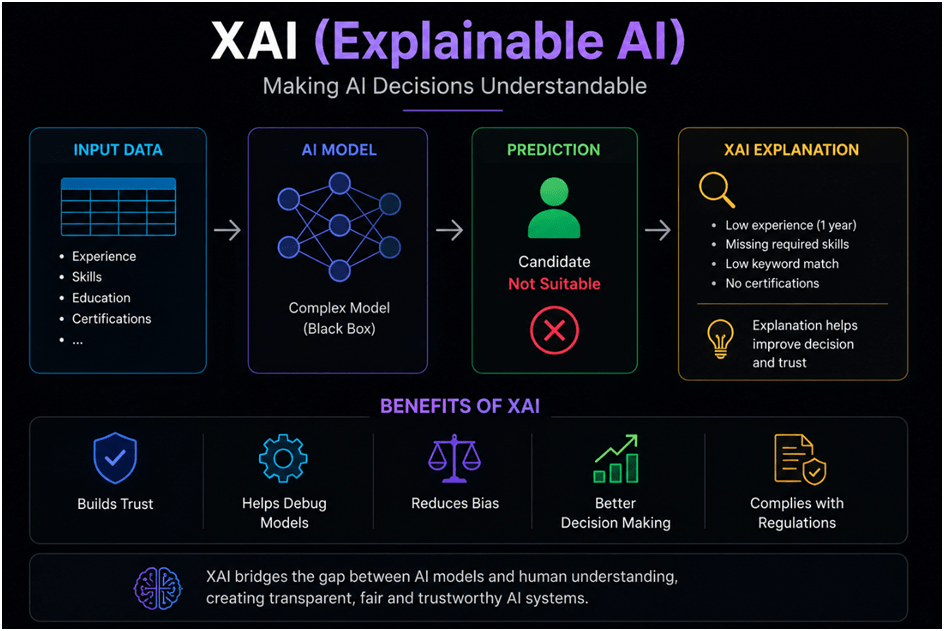
It helps make machine learning models more transparent, interpretable, and trustworthy by explaining how predictions are made.
What is Explainable AI (XAI)?
Explainable AI (XAI) refers to a collection of techniques and methods used to make machine learning models understandable to humans.
Instead of only generating predictions, Explainable AI helps answer critical questions such as:
- Why did the model make this prediction?
- Which features influenced the decision?
- How confident is the model?
- Was the decision fair and unbiased?
In simple terms, Explainable AI transforms complex machine learning systems into transparent and interpretable models that humans can understand and trust.
Why Explainable AI is Important
Modern deep learning and machine learning algorithms often provide high accuracy, but they lack interpretability. This creates risks in industries where decisions directly affect people.
Explainable AI is important because it:
1. Builds Trust in AI Systems
Users are more likely to trust AI systems when they understand how decisions are made.
2. Helps Developers Improve Models
Developers can identify errors, bias, or incorrect logic in machine learning models using Explainable AI techniques.
3. Reduces Bias and Improves Fairness
XAI helps organizations detect discrimination or unfair treatment in AI predictions.
4. Supports Better Decision-Making
Transparent AI systems allow businesses and users to make informed decisions based on understandable insights.
5. Essential for Sensitive Industries
Industries like healthcare, banking, insurance, and recruitment require transparent AI systems for compliance and ethical reasons.
Key Techniques Used in Explainable AI
Several techniques are widely used in Explainable AI to interpret machine learning models.
1. Feature Importance
Feature importance identifies which input variables have the biggest influence on model predictions.
For example, in a loan approval system:
- Credit score may have high importance
- Income level may have medium importance
- Location may have low importance
This helps developers understand which factors affect decisions most.
2. SHAP (SHapley Additive Explanations)
SHAP is one of the most popular this methods.
It assigns a contribution value to every feature in a prediction. SHAP explains:
- Which features increased the prediction
- Which features reduced the prediction
- The overall impact of each variable
SHAP is highly effective for interpreting complex machine learning models.
3. LIME (Local Interpretable Model-Agnostic Explanations)
LIME explains individual predictions by approximating a complex model using a simpler interpretable model.
For example:
If an AI model rejects a job application, LIME can explain the specific reasons behind that rejection.
LIME works well for understanding local predictions rather than the entire model.
Popular Python Tools for Explainable AI
Developers can easily implement this using Python libraries.
Common XAI Libraries:
- SHAP
- LIME
- Scikit-learn
- TensorFlow Explain
- Captum for PyTorch
These tools help developers visualize and interpret machine learning predictions effectively.
Practical Example of Explainable AI
Consider a recruitment platform that uses machine learning to screen resumes.
A traditional AI system may simply output:
“Candidate not suitable.”
This creates confusion because candidates and recruiters do not know the reason behind the decision.
With this the system can provide detailed explanations such as:
- Missing required technical skills
- Insufficient years of experience
- Low keyword match with job requirements
- Lack of certification
This makes the recruitment system more transparent and fair.
Real-World Applications of Explainable AI
This is widely used in multiple industries.
Healthcare
Doctors can understand why an AI model predicted a disease diagnosis.
Finance
Banks use this for transparent loan approval and fraud detection.
Recruitment Systems
Companies use XAI to explain resume screening decisions.
E-commerce
Recommendation systems explain why certain products are suggested.
Cybersecurity
Security analysts can understand why suspicious activity was flagged.
Challenges of Explainable AI
Although this offers many benefits, it also comes with challenges.
1. Complex Models are Difficult to Explain
Deep learning models with millions of parameters are harder to interpret.
2. Accuracy vs Interpretability
Highly accurate models are often less interpretable.
3. Computational Cost
Some XAI methods require additional processing power and computation time.
4. Risk of Misinterpretation
Improper explanations can sometimes confuse users instead of helping them.
Future of Explainable AI
As AI adoption grows, this will become increasingly important.
Governments and organizations are already introducing regulations that require transparency in AI systems. Businesses that use responsible and explainable machine learning models will gain more trust from users and customers.
Future AI systems are expected to focus not only on accuracy but also on fairness, accountability, and interpretability.
Conclusion
Explainable AI is transforming machine learning by making AI systems more transparent, trustworthy, and understandable.
Instead of treating machine learning models as black boxes, XAI helps developers and users understand how predictions are made and why decisions occur.
As AI continues to influence industries like healthcare, finance, recruitment, and e-commerce, Explainable AI is no longer optional. It is becoming an essential part of responsible AI development.
Businesses and developers that adopt Explainable AI techniques will build more ethical, reliable, and trustworthy AI systems in the future.