Intelligent Automation in today’s digital landscape, data is generated continuously from multiple sources such as APIs, databases, spreadsheets, and web applications. While this growing volume of data offers massive potential, managing and extracting value from it remains a challenge. Most organizations rely on automation tools to move data between systems, but these workflows are often limited to predefined rules and repetitive tasks.
This is where Intelligent Automation becomes critical. Traditional automation can transfer and transform data, but it cannot understand, analyze, or generate meaningful insights. As a result, businesses still depend heavily on manual effort to interpret and use their data effectively.
The Gap Between Automation and Intelligence
A major limitation in current systems is the absence of intelligence within automation. While automation tools are efficient at connecting services, triggering actions, and handling data movement, they lack the ability to process context or make decisions.
Without AI-powered automation, workflows remain incomplete. They cannot summarize complex data, identify patterns, or generate insights. This gap prevents organizations from fully utilizing their data and slows down decision-making processes. Even with automation in place, human intervention is still required for higher-level analysis.
How to Enhances Workflow Efficiency
Intelligent Automation bridges the gap between simple AI-powered automation and advanced data processing. By integrating Artificial Intelligence into workflows, systems can go beyond basic tasks and start making sense of the data they handle.
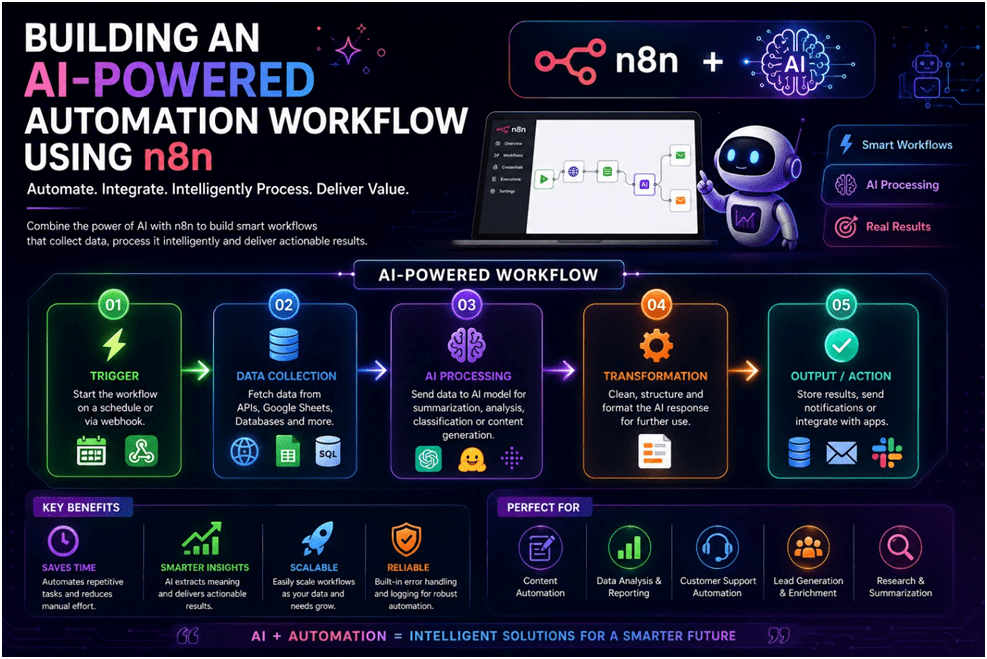
For example, tools like n8n allow developers to create node-based workflows that connect multiple services. When combined with AI capabilities such as text summarization, classification, or content generation, these workflows evolve into intelligent systems.
A typical AI-powered automation workflow might include:
- Triggering a process based on an event
- Collecting data from APIs or spreadsheets
- Sending the data to an AI model for analysis
- Structuring the output into usable formats
- Storing results or notifying users
This end-to-end process shows how Intelligent Automation transforms simple pipelines into powerful data-processing systems.
Benefits of Intelligent Automation for Developers
Building AI-powered automation workflows helps developers gain practical, real-world skills. It pushes them beyond basic automation into system-level thinking, where multiple components must work together efficiently.
Key benefits include:
- Designing scalable automation pipelines
- Integrating AI services into applications
- Handling multi-source data efficiently
- Managing API limitations and errors
- Working with inconsistent or incomplete data
These are not optional skills anymore. If you cannot handle these challenges, you cannot build production-ready systems.
Real-World Example of Intelligent Automation
A clear example of Intelligent Automation can be seen in content automation systems. Imagine collecting articles or raw text from different platforms and processing them automatically.
Without AI-powered automation, the system would only gather and transfer data. With it, the workflow can:
- Summarize content
- Extract key insights
- Classify information
- Generate structured outputs
This shift turns raw data into actionable insights without manual effort, significantly increasing system value.
Why Intelligent Automation Is the Future
Intelligent Automation is not just an upgrade, it is a fundamental shift in how systems are built. It reduces manual work, speeds up data processing, and improves scalability.
More importantly, Intelligent Automation changes how developers approach problem-solving. Instead of just automating repetitive tasks, they start building systems that can think, analyze, and respond.
As digital systems continue to evolve, relying only on basic automation is a limitation. Businesses that adopt AI-powered automation will move faster, make better decisions, and build more scalable solutions.
Conclusion: Moving Toward Intelligent Automation
The combination of AI and automation tools is no longer optional. Intelligent Automation is essential for unlocking the full potential of modern data systems.
If your workflows only move data but do not understand it, they are incomplete. The real value comes when systems can process and generate insights on their own.
That is the difference between automation and AI-powered automation.