Introduction
Retrieval-Augmented Generation Artificial Intelligence is evolving rapidly, especially in the field of natural language processing. Tools like chatbots and AI assistants are now able to generate human-like responses. However, traditional AI models often face one major problem. Their knowledge is limited to the data used during training.
This is where Retrieval-Augmented Generation (RAG) becomes important.
Retrieval-Augmented Generation is an AI technique that improves the quality of responses by combining information retrieval systems with generative AI models. Instead of relying only on pre-trained knowledge, the model retrieves relevant information from external sources and uses it to generate more accurate answers.
This approach makes AI systems more reliable, up-to-date, and useful in real-world applications.
What is Retrieval-Augmented Generation (RAG)?
Retrieval-Augmented Generation (RAG) is a method that enhances AI responses by allowing the system to search for relevant data before generating an answer.
In simple terms, it works in two steps:
- Retrieval – The system searches a knowledge base or document database for relevant information.
- Generation – The AI model uses that retrieved information to generate a detailed and accurate response.
Instead of guessing or relying on outdated knowledge, the model uses real data during the response process.
This makes RAG extremely useful for tasks that require accuracy, context, and updated information.
Why Traditional AI Models Have Limitations
Most AI language models are trained on large datasets. But after training, they do not automatically learn new information.
This causes several problems:
- Outdated knowledge
- Incorrect or hallucinated answers
- Lack of domain-specific information
- Difficulty accessing private or company data
For example, if a model was trained in 2023, it may not know about events or research published after that time.
Retrieval-Augmented Generation solves this issue by allowing the model to retrieve information from external sources such as:
- Company databases
- Research papers
- Documentation
- Knowledge bases
- Websites
How Retrieval-Augmented Generation Works
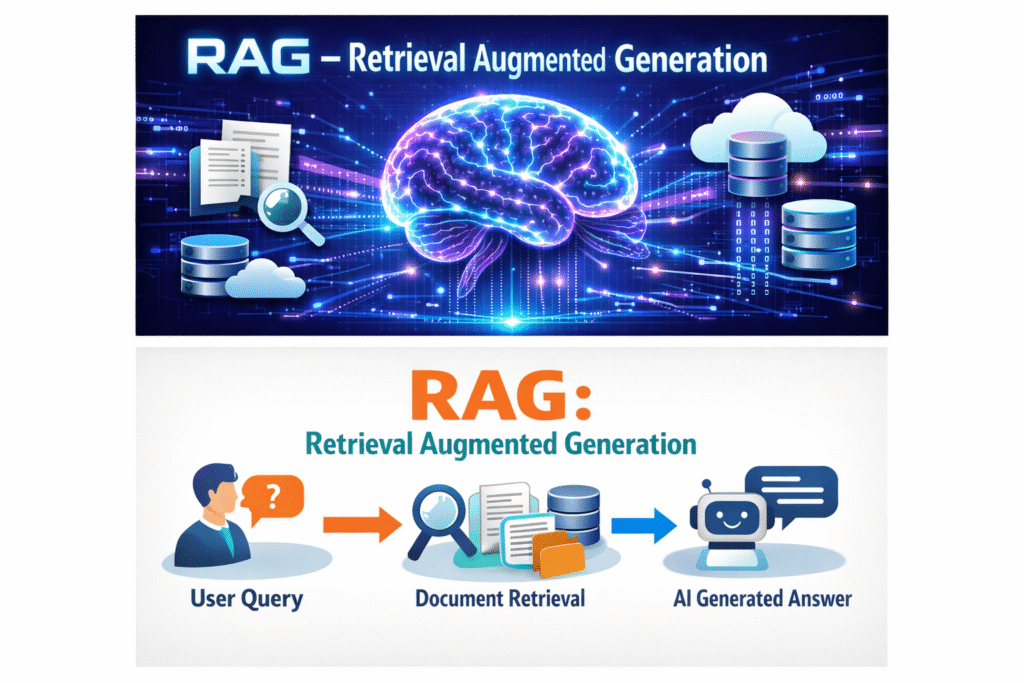
The RAG process involves multiple steps working together.
1. User Query
The process starts when a user asks a question.
Example:
“What are the benefits of Retrieval-Augmented Generation?”
2. Information Retrieval
The system searches a database or knowledge base to find relevant documents or information related to the query.
This step often uses vector databases and embeddings to find the most relevant content.
3. Context Injection
The retrieved information is added as context to the AI model.
4. Response Generation
The AI model then generates a response using both:
- its existing knowledge
- the retrieved data
This combination produces more accurate and context-aware answers.
Key Components of a RAG System
A typical Retrieval-Augmented Generation system includes several important components.
1. Knowledge Base
A collection of documents or data that the system can search.
Examples include PDFs, websites, company documents, and databases.
2. Embedding Model
Text data is converted into numerical vectors so the system can compare meaning and context.
3. Vector Database
Stores embeddings and allows fast similarity searches.
Common tools include Pinecone, Weaviate, and FAISS.
4. Large Language Model (LLM)
The AI model that generates the final response using the retrieved context.
Advantages of Retrieval-Augmented Generation
RAG offers several benefits compared to traditional AI systems.
More Accurate Responses
Since answers are based on real data, the system produces more reliable outputs.
Up-to-Date Information
RAG systems can access current data without retraining the AI model.
Reduced Hallucinations
AI hallucinations happen when models generate incorrect information. RAG reduces this by grounding responses in retrieved sources.
Custom Knowledge Integration
Businesses can integrate their own data, such as internal documentation or customer support knowledge bases.
Better Performance for Specialized Fields
Industries like healthcare, law, and finance require accurate information. RAG improves reliability in these fields.
Real-World Applications of RAG
Retrieval-Augmented Generation is being used across many industries.
AI Customer Support
Companies use RAG-powered chatbots to answer customer queries based on company documentation.
Enterprise Knowledge Systems
Organizations build internal AI assistants that retrieve information from internal databases.
Healthcare AI
Doctors can retrieve medical research and clinical guidelines quickly.
Legal Research
Law firms use RAG to search legal documents and case laws efficiently.
Education Platforms
AI tutors use RAG to provide accurate learning resources and explanations.
Challenges of Retrieval-Augmented Generation
Even though RAG is powerful, it still has some challenges.
Data Quality
If the retrieved documents are incorrect or outdated, the generated response will also be wrong.
Retrieval Accuracy
The system must retrieve the most relevant information. Poor search results reduce answer quality.
Infrastructure Complexity
Building a RAG system requires multiple technologies such as vector databases, embeddings, and LLMs.
Latency
Retrieving documents and generating responses can sometimes slow down the system.
Despite these challenges, RAG is still considered one of the most effective ways to improve AI accuracy.
The Future of Retrieval-Augmented Generation
Retrieval-Augmented Generation is becoming a key architecture for modern AI systems.
Many advanced AI applications are now built using RAG because it allows AI to:
- access external knowledge
- stay updated
- provide more trustworthy responses
As AI technology continues to develop, RAG systems will likely become standard in chatbots, enterprise AI tools, and intelligent assistants.
This approach bridges the gap between static AI models and dynamic real-world information.
Conclusion
Retrieval-Augmented Generation is transforming the way AI systems generate responses. By combining information retrieval with generative models, RAG enables AI to provide more accurate, relevant, and up-to-date answers.
Instead of relying only on training data, AI systems can now access external knowledge sources in real time.
As organizations continue adopting AI solutions, Retrieval-Augmented Generation will play a major role in building smarter and more reliable AI applications.